
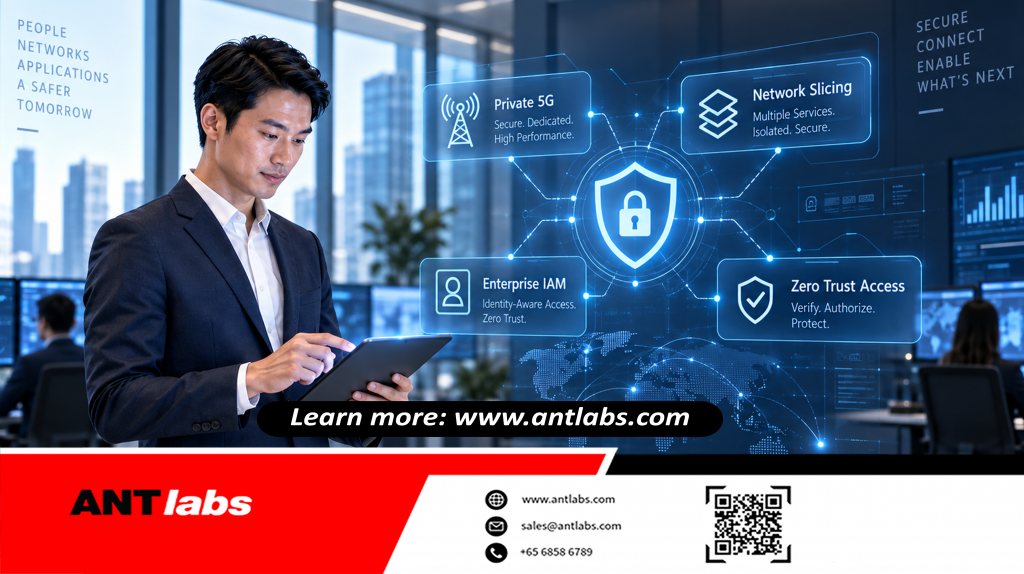
Private 5G Security: Closing the Identity Gap from Connection to Enterprise Application
How ANTlabs brings mobile-network context and enterprise identity together to protect sensitive business resources
Private 5G is transforming enterprise connectivity. From campuses and hotels to industrial facilities and distributed operational sites, Mobile Private Networks (MPNs) give organisations greater control over mobile coverage, performance and traffic separation. Network slicing further enables operators to tailor connectivity to different enterprise and application requirements.
For customers handling sensitive business information, that connectivity foundation raises an important question: Does an authorised mobile connection also mean the person accessing an enterprise portal is authorised to use it?
The answer depends on how closely mobile-network identity and enterprise access controls work together.
ANTlabs helps close this identity gap by connecting private mobile-session context with enterprise Identity and Access Management (IAM). This enables access decisions to consider both the connection and the user, supporting a more complete security architecture from mobile access through to enterprise applications.
Understanding the Security Gap in Private 5G
Private 5G provides important security capabilities. SIM or eSIM authentication establishes the validity of a mobile subscription, while private APNs, DNNs and network slices can support enterprise-specific routing, traffic separation and service policies.
However, these capabilities serve different purposes from enterprise user authentication and application authorisation.
A valid subscription does not, by itself, establish which employee is currently using a device. Membership of an enterprise network slice does not determine whether that person should access payroll records, financial systems or an administrative portal.
Where mobile-network and enterprise identity systems operate independently, several gaps can remain:
- ·The connection and login may belong to different people. An authorised mobile session could be used to present another person’s shared, misused or compromised credentials.
- ·Network access may be broader than the user’s role requires. Reaching the enterprise environment should not automatically provide access to every resource within it.
- ·Mobile-session context may be absent from application access decisions. Enterprise controls may authenticate a login without checking its association with the active private mobile session.
- ·Identity mappings can become outdated. Device reassignment, subscription changes and employee departures require corresponding updates to access policies.
These are integration gaps that enterprises should assess in their deployment. Their significance depends on the controls already in place.
The underlying Zero Trust Principle is clear: network location alone should not establish trust in a user or device. Access must be evaluated against identity and policy.
ANTlabs Connects the Mobile Session to Enterprise Identity
ANTlabs provides the identity-mapping and policy-enablement layer between the mobile network and the enterprise security environment.
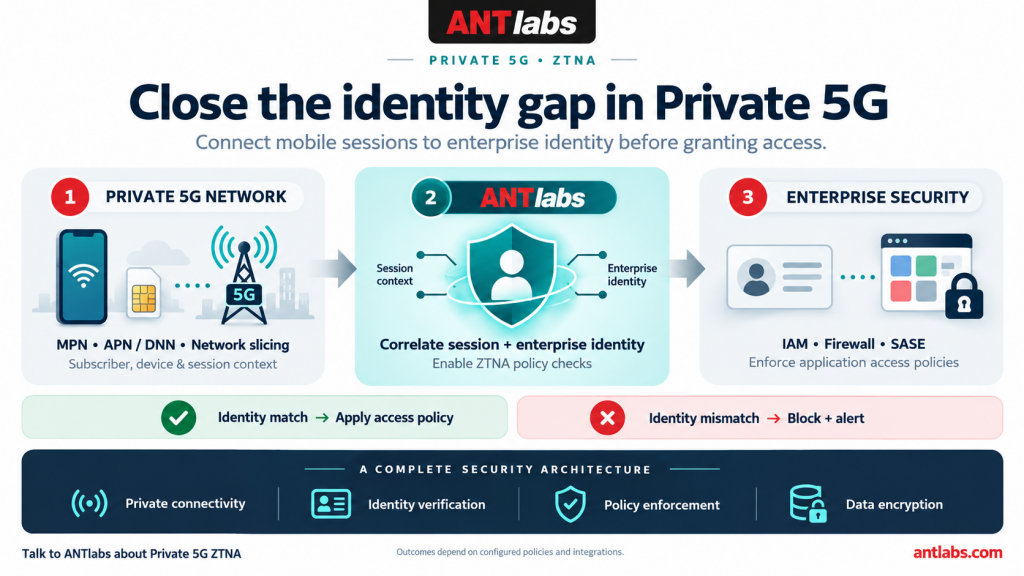
Depending on the deployment and available interfaces, mobile-network context can include the SIM’s subscriber identifier, device information such as the IMEI, and the IP address associated with the active session. ANTlabs correlates this context with the relevant enterprise user or group.
Enterprise IAM supplies the complementary information: the user’s account, role, group membership and access permissions.
Bringing these contexts together allows the security architecture to evaluate whether the mobile session and the identity presented at login are consistent with the enterprise’s authorized mappings. ANTlabs enables that context to inform the access decision, while integrated enterprise controls enforce the appropriate policy. Learn more about Private 5G
A successful identity match is one input to that decision. Application permissions, authentication requirements, device posture and other configured conditions still apply.
Preventing Access Under the Wrong Identity
Consider an employee whose private 5G subscription is associated with their enterprise account. The employee connects through an authorised mobile session and attempts to access a sensitive finance portal. If the login corresponds to the authorized session-to-user mapping, the enterprise can evaluate the request against that employee’s role and the portal’s security requirements.
Now consider the same connection presenting a different employee’s finance credentials. Without correlation between the two identity systems, the mobile network and the application could each accept their respective credentials without recognising the inconsistency.
With an explicit identity-consistency policy and integrated enforcement, the mismatch can trigger a block and an alert before access is granted. This adds a valuable check against mistaken identity and credential misuse. For shared devices or pooled subscriptions, the organization must define the permitted user relationships and authentication requirements. A subscription identifier is useful security context; it is not proof of the person holding the device.
Building the Total Solution for Private Data Security
An end-to-end private 5G security architecture needs coordinated protection across connectivity, identity, applications and data. The mobile network provides controlled connectivity and traffic separation. Enterprise IAM establishes user identity and permissions. Security enforcement platforms apply access decisions. Encryption protects data in transit, while endpoint and application controls address risks at either end of the connection.
ANTlabs adds the connection between mobile-session context and enterprise access policy, helping these components operate as a complete solution using their Tru’Auth platform.
This distinction matters for customers evaluating private 5G. A private network or network slice does not automatically provide end-to-end application encryption or prevent every form of unauthorised access. Those outcomes depend on the design and configuration of the complete environment.
By integrating mobile identity into the enterprise security architecture, ANTlabs helps customers strengthen the access path to sensitive resources while retaining the controls needed to protect the data itself.
Extending Existing Enterprise Security Investments
Most enterprises already maintain IAM, firewall, Secure Access Service Edge (SASE), Network Access Control (NAC) and application-security platforms.
ANTlabs enables private mobile sessions to participate in that established policy environment. Subject to supported integrations, the correlated user and session context can inform application access, filtering and traffic-management policies.
For customers, this creates practical benefits:
- •More precise access: Employees and contractors receive access aligned with their authorised roles.
- •Stronger identity checks: Inconsistent mobile-session and login identities can be identified and acted upon.
- •Consistent policies: Private cellular access can follow the organisation’s existing identity and security structure.
- •Better use of existing investments: Enterprise security platforms continue to perform their enforcement roles.
A university can distinguish students, faculty and administrative staff using shared mobile infrastructure. A hospitality group can separate employee and contractor access across properties. Industrial and automotive organisations can restrict operational personnel to the applications required for their work.
In each case, connectivity supports mobility while enterprise identity governs access.
A Stronger Managed-Service Proposition for Operators
For mobile operators, this integration expands the value of MPN and network-slicing services.
Alongside coverage, performance and Quality of Service, operators can offer enterprise identity integration and ZTNA policy enablement as part of a managed security proposition. This creates a path towards Security as a Service (SECaaS), with connectivity and enterprise access requirements addressed within the same service design.
Multi-enterprise deployments can preserve each customer’s identity mappings and policy boundaries while using a shared service platform. Clear separation between customers and well-defined integration responsibilities remain essential.
The result is a service proposition that addresses a business priority: helping the right people reach the right resources through an appropriately controlled mobile connection.
Bringing Connectivity, Identity and Policy Together
Private 5G gives enterprises a powerful foundation for mobile operations. A complete security approach connects that foundation to the identities, permissions and controls protecting the organisation’s applications and data.
ANTlabs Private 5G ZTNA helps make that connection. By correlating mobile-network context with enterprise IAM, ANTlabs enables more informed access decisions and helps prevent identity mismatches from becoming unauthorised access to sensitive enterprise portals.
For enterprises, this supports a more complete approach to private data security. For operators, it creates a stronger offering around secure, identity-aware private 5G services.
Build your private 5G service around connectivity, identity and enterprise protection. Talk to the ANTlabs solutions team about your MPN, network-slicing and ZTNA requirements.
Talk to our team about building your scalable hospitality platform today.